
Logic Path Math
timeline
2024 – Present
role
Founder
Lead Math Tutor
Curriculum Designer
skills
Advanced Mathematical Modeling, Curriculum Development, Pedagogical Translation, Gender Equity Advocacy, Community Leadership.
Problem Statement
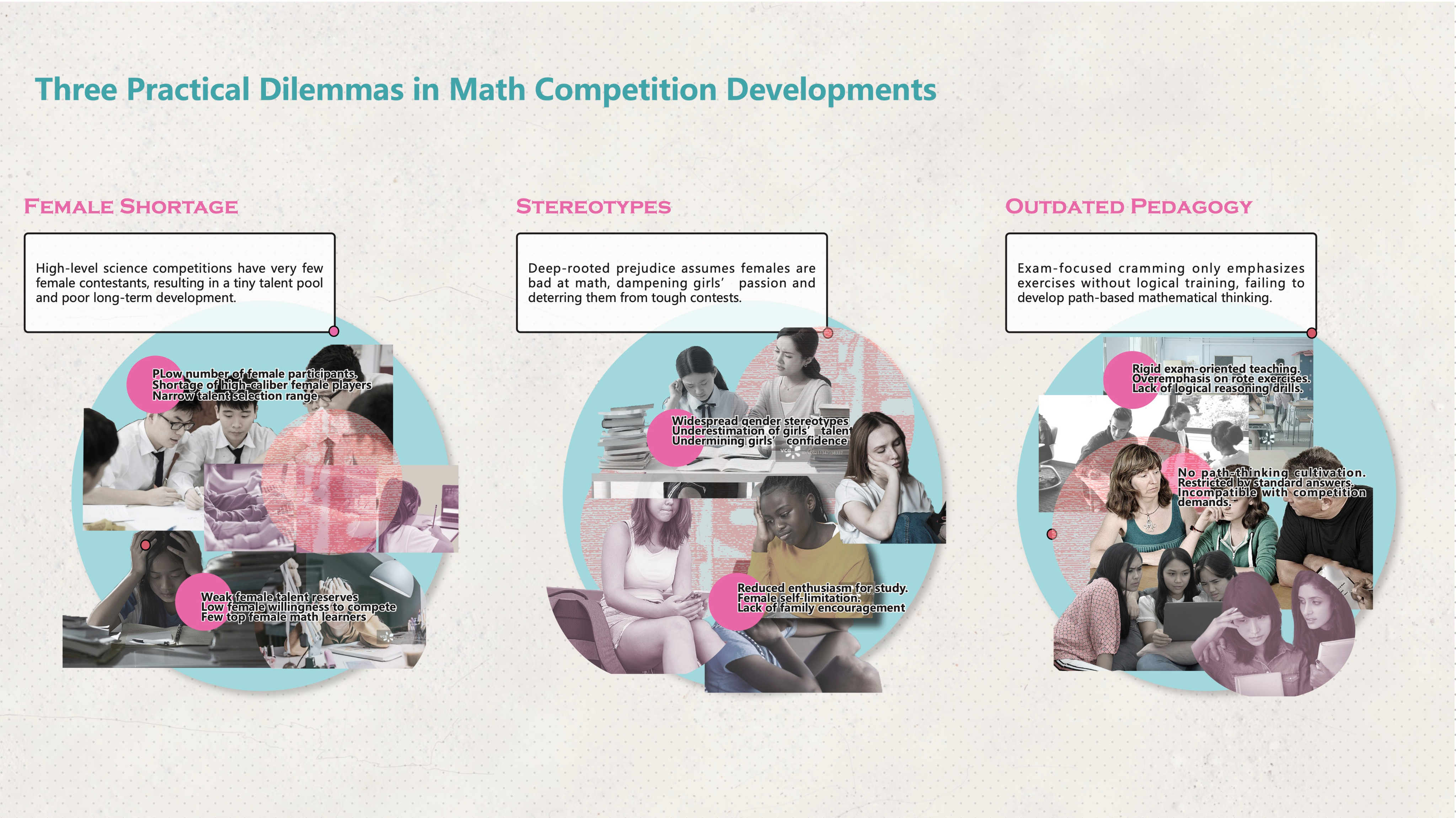
As a girl who has participated in AMC and AIME competitions, I noticed that female students were often underrepresented in advanced mathematics and competitive STEM spaces. This gap is not simply about ability; it is shaped by confidence, social expectations, and the way math is often taught. Many girls begin to believe that abstract or difficult mathematics is “not for them,” especially when classroom examples, peer culture, and traditional teaching methods make the subject feel distant or intimidating.
To challenge this pattern, I founded Logic Path Math, a student-led nonprofit organization that is currently being developed for girls in grades 5–8. The project focuses on designing supportive and engaging curricula around carefully selected topics such as graph theory, knot theory, topology, and networks. By translating these subjects into relatable visual activities, I hope to make advanced mathematics more accessible while helping girls discover its deeper meaning, creativity, and beauty.
Research
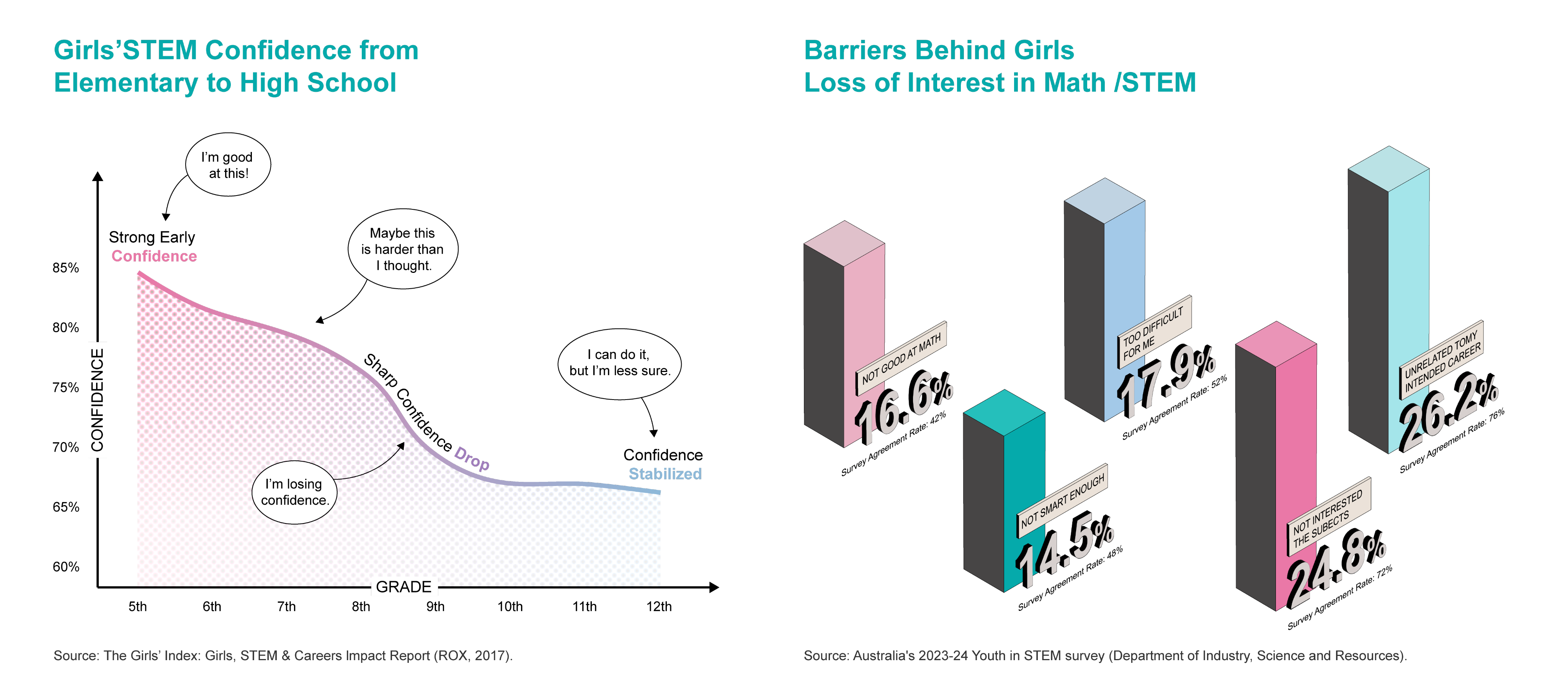
In the research phase, I used three visualizations to define both the problem and the curriculum direction. The line chart shows that girls’ STEM confidence declines from 84% in 5th grade to 66% in 12th grade, with the sharpest drop occurring before high school. The pie chart further explains why girls may move away from math: limited perceptions of career relevance, lack of interest, perceived difficulty, and low self-confidence are major barriers.
Based on these findings, the Venn diagram helped me identify the curriculum focus: carefully selected areas of advanced pure mathematics that can be visualized, connected to relatable problems, and made engaging for girls in grades 5–8. The selection process considers not only whether a topic is intellectually meaningful, but also whether it can reveal a different side of mathematics without reproducing the competitive and intimidating atmosphere that often discourages girls from advanced STEM.
Action
Curriculum Design
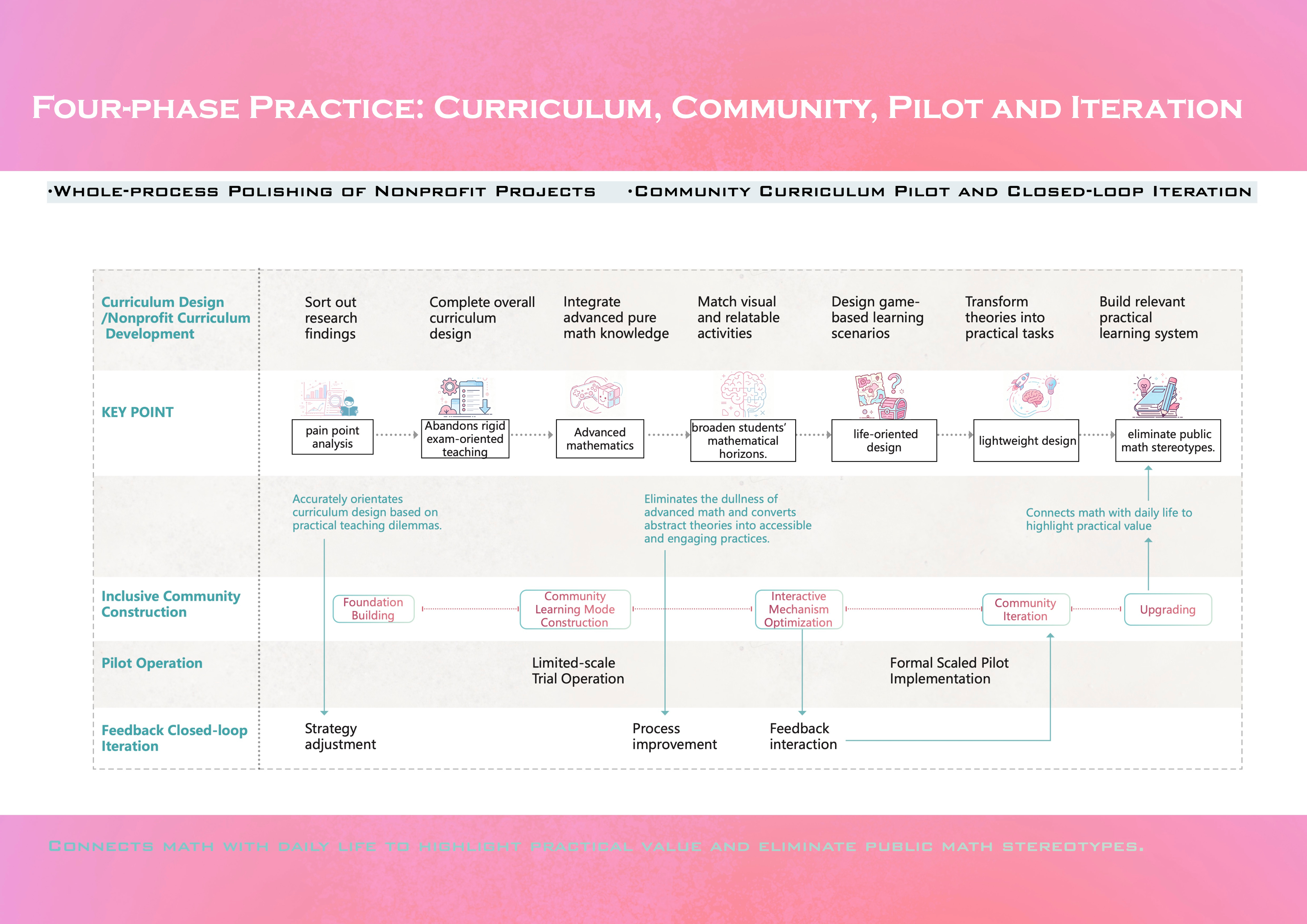
Based on the research findings, I began developing lessons that connect advanced pure mathematics with visual, playful, and relatable activities. I carefully selected topics such as graph theory, knot theory, topology, and networks because they reveal forms of mathematical reasoning that students rarely encounter in conventional classrooms.
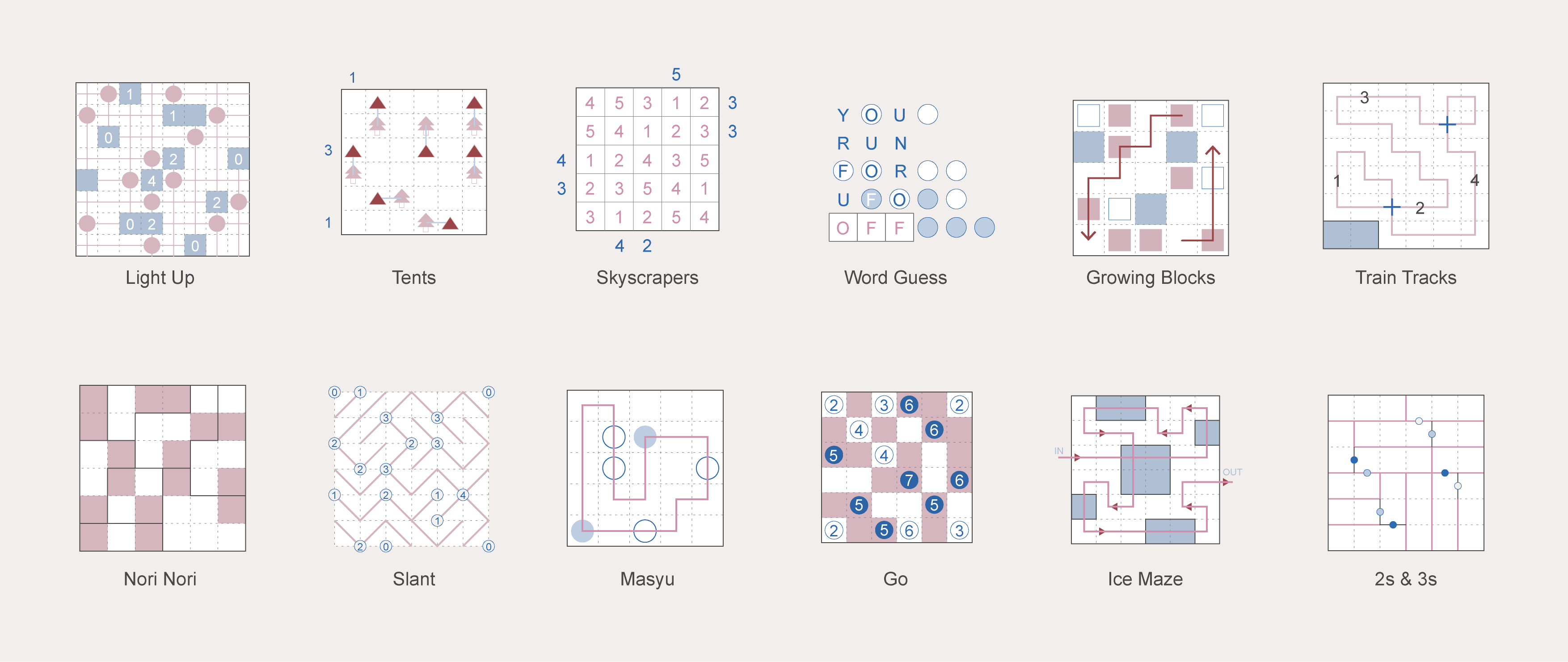
These concepts were translated into games, puzzles, social-network mapping, knot-based challenges, and treasure-hunt problems. The lessons are designed not merely to simplify difficult material, but to preserve its underlying logic while making it approachable for girls in grades 5–8. Through this curriculum, I hope students can experience mathematics as concrete and creative, while also recognizing its meaning, structure, and beauty.
Safe Space & Mentorship
Because confidence was a central barrier, I built a female-to-female learning environment where girls could ask questions without fear of judgment. Instead of emphasizing speed or competition, the sessions encouraged exploration, discussion, and peer support. Mentorship helped students see that struggling with difficult math was part of learning, not proof of inability.
Pilot Testing
As Logic Path Math is still being developed, the next stage is to recruit a small group of girls in grades 5–8 for pilot lessons. During the sessions, I plan to observe how students respond to abstract concepts presented through visual and relatable tasks. I will track participation, questions asked, activity completion, and willingness to explain mathematical ideas.
Feedback Loop & Refinement
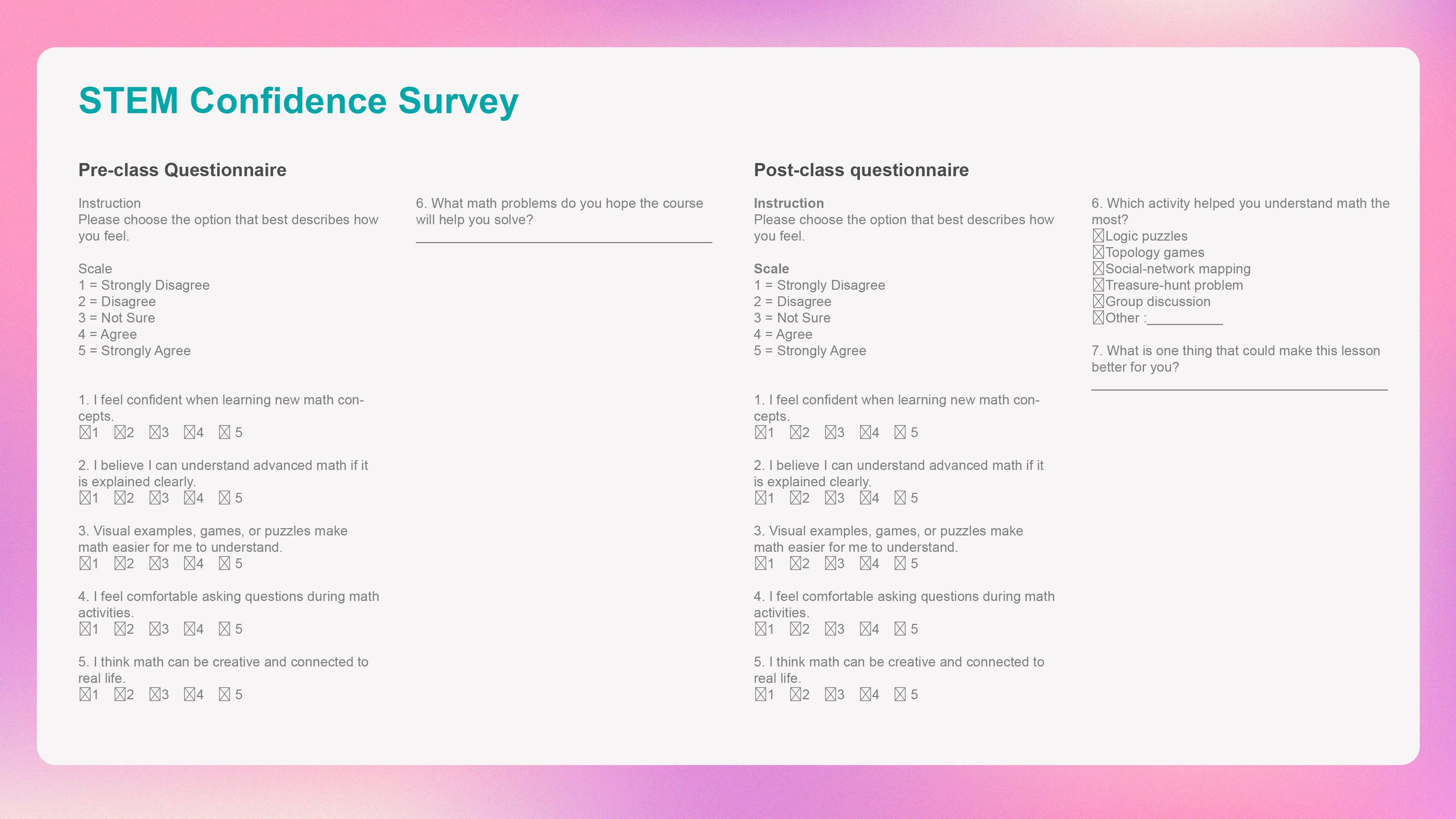
After each pilot session, I plan to collect feedback through a short STEM confidence survey and informal discussion. By comparing students’ responses before and after each lesson, I will refine the activity sequence, visual examples, topic selection, and explanation style.
This feedback loop will help determine whether the curriculum is accessible and engaging, while also examining changes in confidence, willingness to participate, and perceptions of who belongs in advanced mathematics. The findings will guide the continued development of lessons that are intellectually meaningful and better aligned with girls’ learning experiences.
Future Vision
Logic Path Math is not simply a tutoring project, but a student-led nonprofit initiative that seeks to reshape the educational language surrounding advanced mathematics. First, I hope to make carefully selected abstract concepts visual, creative, and connected to the lives of girls in grades 5–8. By introducing topics such as graph theory and knot theory in relatable ways, the project reveals sides of mathematics that are rarely visible in exam-focused classrooms.
Second, the project advocates for systematic change by examining how gender expectations, teaching methods, and competitive learning environments influence girls’ confidence in STEM. Through supportive curriculum design, female mentorship, and early exposure, I hope to make advanced mathematics feel like a space in which girls are entitled to participate, question, and succeed.
Finally, founding and developing Logic Path Math has become the starting point of my own academic exploration. It has helped me understand mathematics not only as problem-solving, but also as a field shaped by access, identity, and educational structures. The project therefore connects my interest in mathematical reasoning with my commitment to gender equity and social impact.

home
problem statement
Research
Action
future vision

back to top
Logic Path Math
timeline
2024 – Present
role
Founder
Lead Math Tutor
Curriculum Designer
skills
Advanced Mathematical Modeling, Curriculum Development, Pedagogical Translation, Gender Equity Advocacy, Community Leadership.
Problem Statement
As a girl who has participated in AMC and AIME competitions, I noticed that female students were often underrepresented in advanced mathematics and competitive STEM spaces. This gap is not simply about ability; it is shaped by confidence, social expectations, and the way math is often taught. Many girls begin to believe that abstract or difficult mathematics is “not for them,” especially when classroom examples, peer culture, and traditional teaching methods make the subject feel distant or intimidating.
To challenge this pattern, I founded Logic Path Math, a student-led nonprofit organization that is currently being developed for girls in grades 5–8. The project focuses on designing supportive and engaging curricula around carefully selected topics such as graph theory, knot theory, topology, and networks. By translating these subjects into relatable visual activities, I hope to make advanced mathematics more accessible while helping girls discover its deeper meaning, creativity, and beauty.
Research
In the research phase, I used three visualizations to define both the problem and the curriculum direction. The line chart shows that girls’ STEM confidence declines from 84% in 5th grade to 66% in 12th grade, with the sharpest drop occurring before high school. The pie chart further explains why girls may move away from math: limited perceptions of career relevance, lack of interest, perceived difficulty, and low self-confidence are major barriers.
Based on these findings, the Venn diagram helped me identify the curriculum focus: carefully selected areas of advanced pure mathematics that can be visualized, connected to relatable problems, and made engaging for girls in grades 5–8. The selection process considers not only whether a topic is intellectually meaningful, but also whether it can reveal a different side of mathematics without reproducing the competitive and intimidating atmosphere that often discourages girls from advanced STEM.
Action
Curriculum Design
Based on the research findings, I began developing lessons that connect advanced pure mathematics with visual, playful, and relatable activities. I carefully selected topics such as graph theory, knot theory, topology, and networks because they reveal forms of mathematical reasoning that students rarely encounter in conventional classrooms.
These concepts were translated into games, puzzles, social-network mapping, knot-based challenges, and treasure-hunt problems. The lessons are designed not merely to simplify difficult material, but to preserve its underlying logic while making it approachable for girls in grades 5–8. Through this curriculum, I hope students can experience mathematics as concrete and creative, while also recognizing its meaning, structure, and beauty.
Safe Space & Mentorship
Because confidence was a central barrier, I built a female-to-female learning environment where girls could ask questions without fear of judgment. Instead of emphasizing speed or competition, the sessions encouraged exploration, discussion, and peer support. Mentorship helped students see that struggling with difficult math was part of learning, not proof of inability.
Pilot Testing
As Logic Path Math is still being developed, the next stage is to recruit a small group of girls in grades 5–8 for pilot lessons. During the sessions, I plan to observe how students respond to abstract concepts presented through visual and relatable tasks. I will track participation, questions asked, activity completion, and willingness to explain mathematical ideas.
Feedback Loop & Refinement
After each pilot session, I plan to collect feedback through a short STEM confidence survey and informal discussion. By comparing students’ responses before and after each lesson, I will refine the activity sequence, visual examples, topic selection, and explanation style.
This feedback loop will help determine whether the curriculum is accessible and engaging, while also examining changes in confidence, willingness to participate, and perceptions of who belongs in advanced mathematics. The findings will guide the continued development of lessons that are intellectually meaningful and better aligned with girls’ learning experiences.
Future Vision
Logic Path Math is not simply a tutoring project, but a student-led nonprofit initiative that seeks to reshape the educational language surrounding advanced mathematics. First, I hope to make carefully selected abstract concepts visual, creative, and connected to the lives of girls in grades 5–8. By introducing topics such as graph theory and knot theory in relatable ways, the project reveals sides of mathematics that are rarely visible in exam-focused classrooms.
Second, the project advocates for systematic change by examining how gender expectations, teaching methods, and competitive learning environments influence girls’ confidence in STEM. Through supportive curriculum design, female mentorship, and early exposure, I hope to make advanced mathematics feel like a space in which girls are entitled to participate, question, and succeed.
Finally, founding and developing Logic Path Math has become the starting point of my own academic exploration. It has helped me understand mathematics not only as problem-solving, but also as a field shaped by access, identity, and educational structures. The project therefore connects my interest in mathematical reasoning with my commitment to gender equity and social impact.

home
problem statement
Research
Action
future vision

back to top
Logic Path Math
timeline
2024 – Present
role
Founder
Lead Math Tutor
Curriculum Designer
skills
Advanced Mathematical Modeling, Curriculum Development, Pedagogical Translation, Gender Equity Advocacy, Community Leadership.
Problem Statement
As a girl who has participated in AMC and AIME competitions, I noticed that female students were often underrepresented in advanced mathematics and competitive STEM spaces. This gap is not simply about ability; it is shaped by confidence, social expectations, and the way math is often taught. Many girls begin to believe that abstract or difficult mathematics is “not for them,” especially when classroom examples, peer culture, and traditional teaching methods make the subject feel distant or intimidating.
To challenge this pattern, I founded Logic Path Math, a student-led nonprofit organization that is currently being developed for girls in grades 5–8. The project focuses on designing supportive and engaging curricula around carefully selected topics such as graph theory, knot theory, topology, and networks. By translating these subjects into relatable visual activities, I hope to make advanced mathematics more accessible while helping girls discover its deeper meaning, creativity, and beauty.
Research
In the research phase, I used three visualizations to define both the problem and the curriculum direction. The line chart shows that girls’ STEM confidence declines from 84% in 5th grade to 66% in 12th grade, with the sharpest drop occurring before high school. The pie chart further explains why girls may move away from math: limited perceptions of career relevance, lack of interest, perceived difficulty, and low self-confidence are major barriers.
Based on these findings, the Venn diagram helped me identify the curriculum focus: carefully selected areas of advanced pure mathematics that can be visualized, connected to relatable problems, and made engaging for girls in grades 5–8. The selection process considers not only whether a topic is intellectually meaningful, but also whether it can reveal a different side of mathematics without reproducing the competitive and intimidating atmosphere that often discourages girls from advanced STEM.
Action
Curriculum Design
Based on the research findings, I began developing lessons that connect advanced pure mathematics with visual, playful, and relatable activities. I carefully selected topics such as graph theory, knot theory, topology, and networks because they reveal forms of mathematical reasoning that students rarely encounter in conventional classrooms.
These concepts were translated into games, puzzles, social-network mapping, knot-based challenges, and treasure-hunt problems. The lessons are designed not merely to simplify difficult material, but to preserve its underlying logic while making it approachable for girls in grades 5–8. Through this curriculum, I hope students can experience mathematics as concrete and creative, while also recognizing its meaning, structure, and beauty.
Safe Space & Mentorship
Because confidence was a central barrier, I built a female-to-female learning environment where girls could ask questions without fear of judgment. Instead of emphasizing speed or competition, the sessions encouraged exploration, discussion, and peer support. Mentorship helped students see that struggling with difficult math was part of learning, not proof of inability.
Pilot Testing
As Logic Path Math is still being developed, the next stage is to recruit a small group of girls in grades 5–8 for pilot lessons. During the sessions, I plan to observe how students respond to abstract concepts presented through visual and relatable tasks. I will track participation, questions asked, activity completion, and willingness to explain mathematical ideas.
Feedback Loop & Refinement
After each pilot session, I plan to collect feedback through a short STEM confidence survey and informal discussion. By comparing students’ responses before and after each lesson, I will refine the activity sequence, visual examples, topic selection, and explanation style.
This feedback loop will help determine whether the curriculum is accessible and engaging, while also examining changes in confidence, willingness to participate, and perceptions of who belongs in advanced mathematics. The findings will guide the continued development of lessons that are intellectually meaningful and better aligned with girls’ learning experiences.
Future Vision
Logic Path Math is not simply a tutoring project, but a student-led nonprofit initiative that seeks to reshape the educational language surrounding advanced mathematics. First, I hope to make carefully selected abstract concepts visual, creative, and connected to the lives of girls in grades 5–8. By introducing topics such as graph theory and knot theory in relatable ways, the project reveals sides of mathematics that are rarely visible in exam-focused classrooms.
Second, the project advocates for systematic change by examining how gender expectations, teaching methods, and competitive learning environments influence girls’ confidence in STEM. Through supportive curriculum design, female mentorship, and early exposure, I hope to make advanced mathematics feel like a space in which girls are entitled to participate, question, and succeed.
Finally, founding and developing Logic Path Math has become the starting point of my own academic exploration. It has helped me understand mathematics not only as problem-solving, but also as a field shaped by access, identity, and educational structures. The project therefore connects my interest in mathematical reasoning with my commitment to gender equity and social impact.