
Sage Hill American Rocketry Team
timeline
2024 – Present
role
Math Director
Lead Treasurer
skills
Aerodynamic Calculus, 3D CAD Modeling, Operations Research, Data-Driven Engineering.
inspiration
Where is the boundary between abstract formulas and real-world physical laws?
In rocketry, I saw a clear bridge between abstract equations on paper and the physical laws that shape the real world. Calculus was no longer only a classroom exercise; it became a tool for predicting drag, thrust, stability, and flight trajectory. As Math Director and Lead Treasurer of the student-led Sage Hill American Rocketry Team, I worked with my teammates to design and build our own rockets from scratch for The American Rocketry Competition (TARC).
Meeting every week, we developed 3D models, performed mathematical calculations, constructed physical rockets, and conducted test launches. Through this project, I wanted to explore how mathematical reasoning could be transformed into a functional rocket. It inspired me because it proved that math is not merely a process of deduction, but a creative force capable of designing, optimizing, and launching something real.
Action
Phase 1: Theoretical Derivation & Modeling
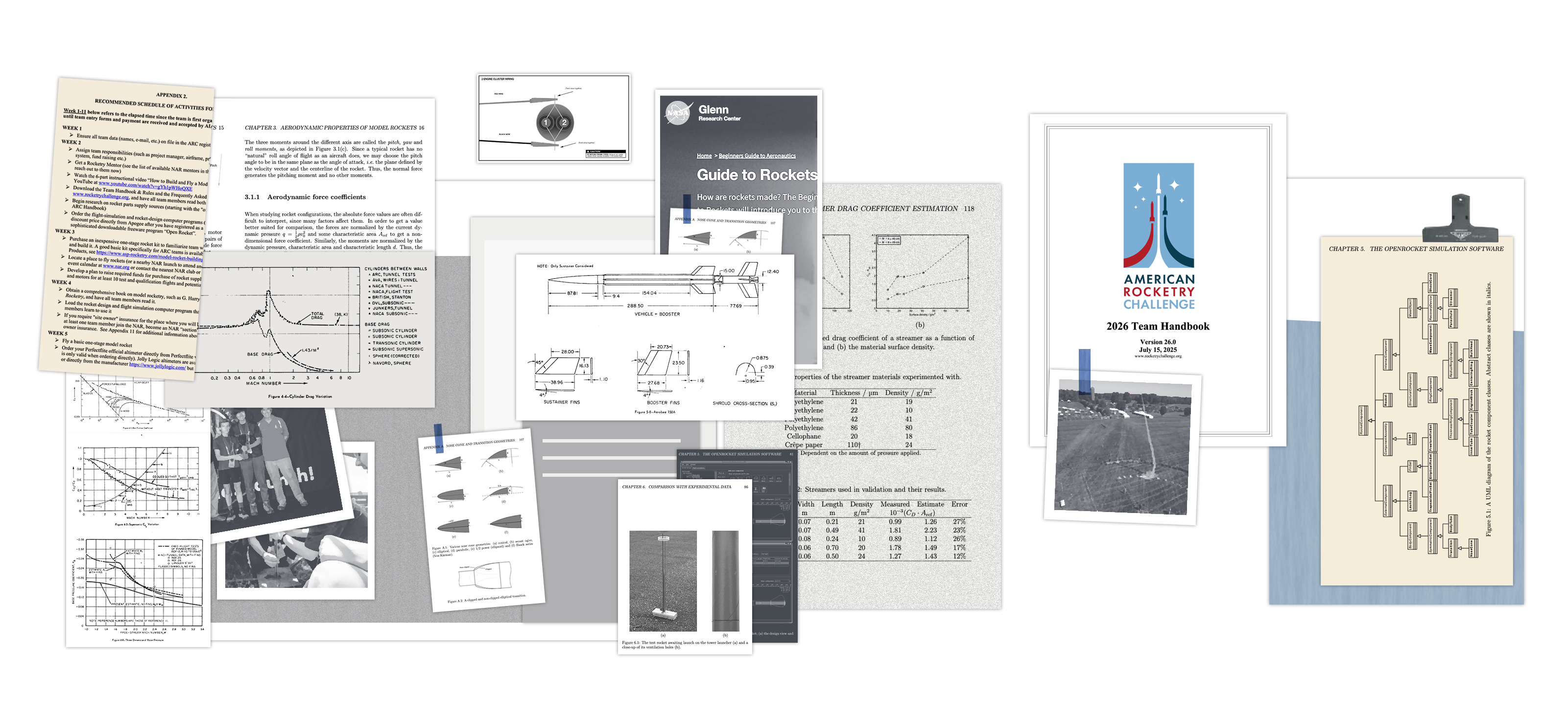
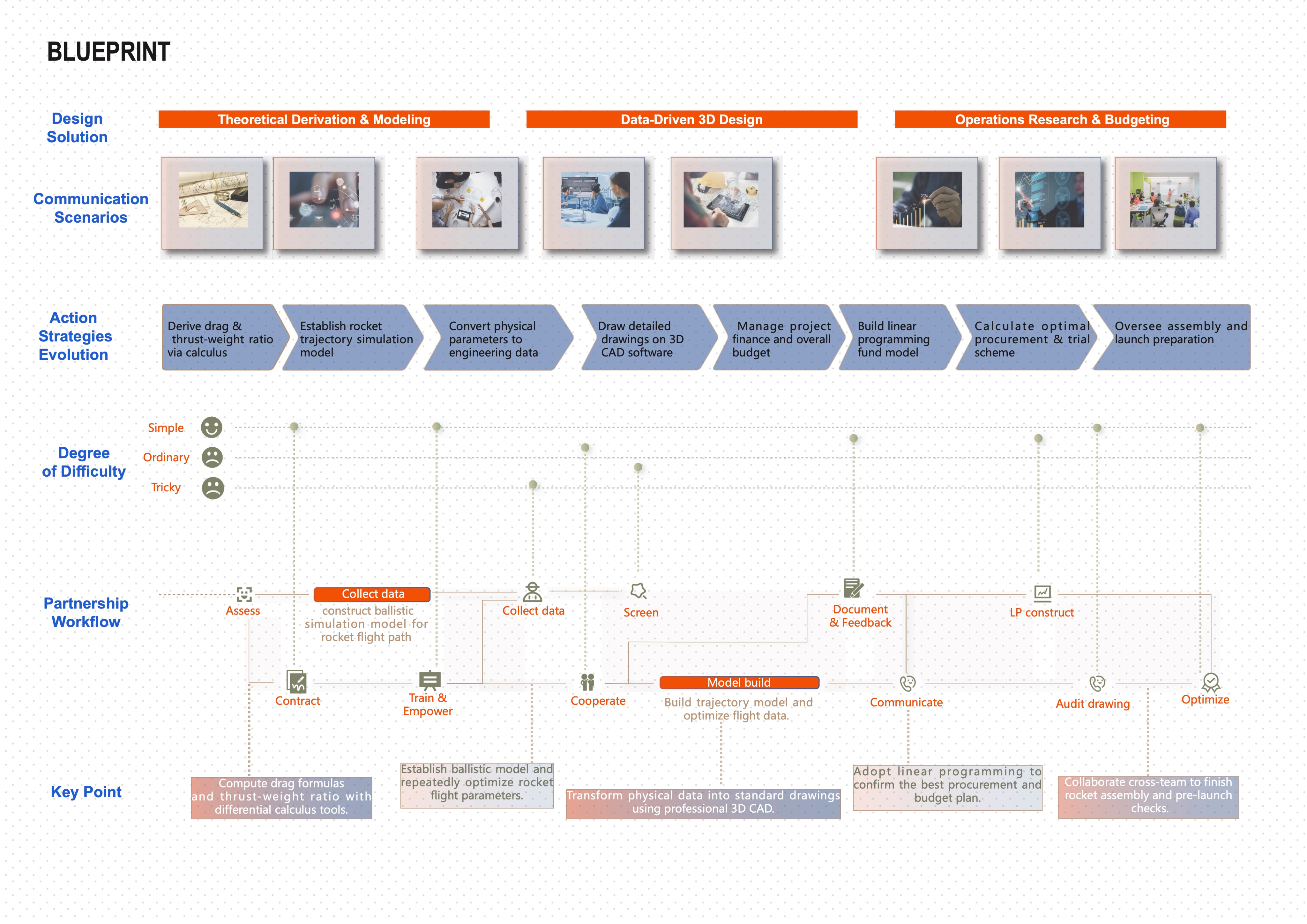
As Math Director, I began by translating the rocket’s flight problem into mathematical variables. Using calculus, I derived basic relationships for drag, thrust-to-weight ratio, acceleration, and projected flight path. These equations helped me build a ballistic simulation model in which different assumptions could be tested before any physical design decisions were made. This phase allowed the team to move from intuition to measurable prediction.
Phase 2: Data-Driven 3D Design
After the modeling phase, I converted the calculated physical parameters into engineering data for 3D CAD design. Dimensions, weight distribution, fin structure, and stability requirements were adjusted according to the simulation results. Instead of designing the rocket based only on appearance, I used data to guide its shape and structure, making the CAD blueprint a direct extension of the mathematical model.
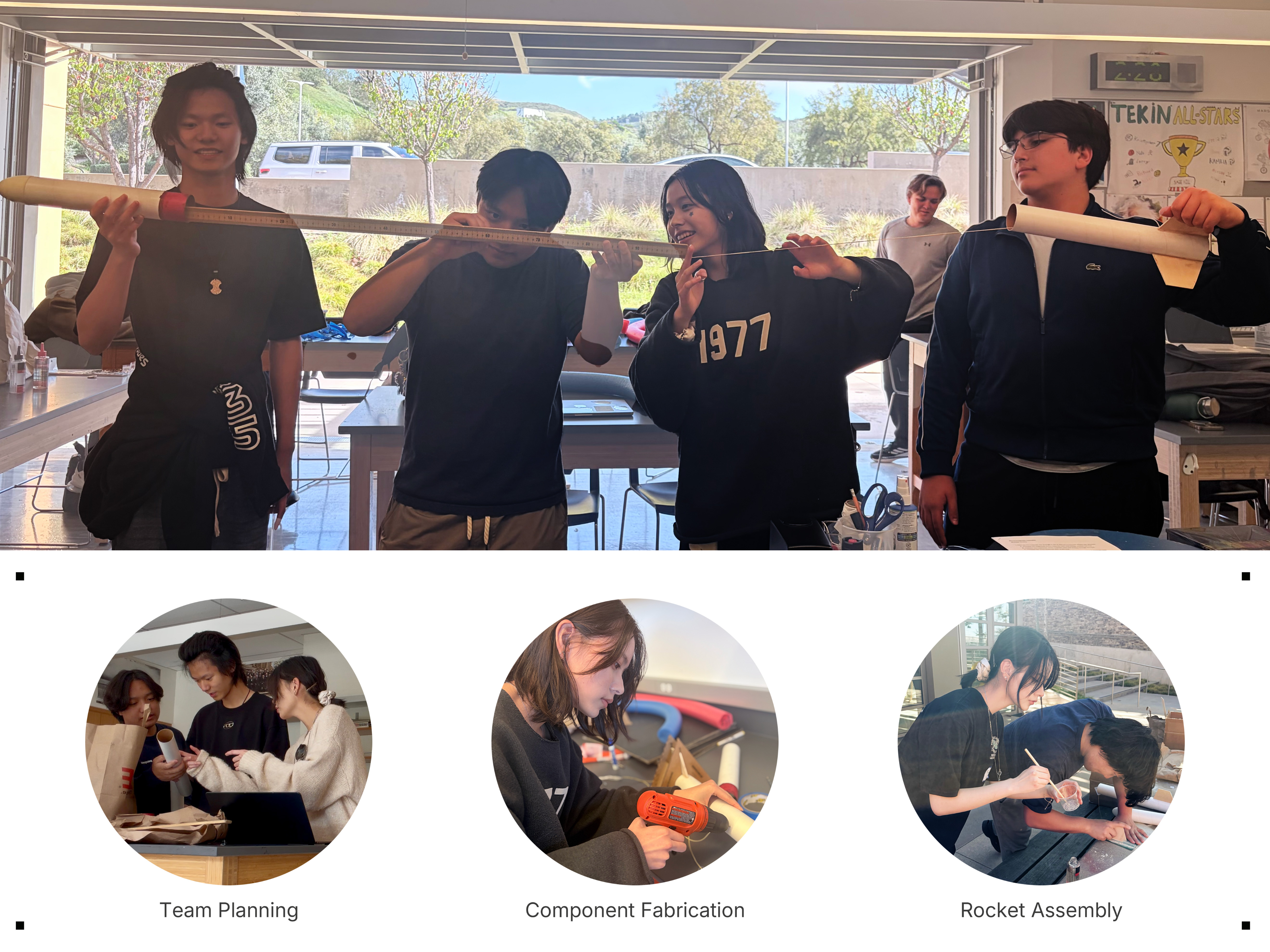
The team then translated the digital design into a physical rocket. We selected materials, fabricated components, assembled the rocket from scratch, and checked whether the completed structure matched the calculated dimensions, mass distribution, and stability requirements.
Phase 3: Operations Research & Budgeting
As Lead Treasurer, I managed the project budget and turned financial decisions into an optimization problem. I compared material costs, procurement options, testing needs, and available funding, then used a linear programming approach to identify the most efficient purchasing and testing plan. This helped the team control costs while still securing the parts and resources needed for construction, repeated test launches, and competition preparation.
>>> Click to check our Basic Financial Model
Impact & Metrics
Our weekly test launches provided a practical way to verify and refine the mathematical model. The rocket reached an estimated altitude of 78 meters, compared with a predicted altitude of 82 meters, resulting in an approximate 4.9% prediction error. Across three trial launches, the achieved heights improved from 61 meters to 72 meters and finally to 78 meters, showing that our adjustments to drag assumptions, weight distribution, and recovery timing were effective.
Financially, the team used approximately 92% of the planned budget while maintaining a small contingency reserve. These results demonstrated both technical improvement and responsible budget control. Our overall performance also earned the team qualification as a Finals Alternate in The American Rocketry Competition.
Future Vision
Looking forward, I hope to refine the model with more accurate sensor data, improve flight prediction, and apply the same mathematical thinking to broader engineering challenges. This project showed me that math can turn abstract ideas into measurable physical impact—and that a student-led team can transform weekly calculations, designs, and experiments into a competition-ready rocket.

home
Inspiration
Action
Impact & Metrics
Future Vision

back to top
Sage Hill American Rocketry Team
timeline
2024 – Present
role
Math Director
Lead Treasurer
skills
Aerodynamic Calculus, 3D CAD Modeling, Operations Research, Data-Driven Engineering.
inspiration
Where is the boundary between abstract formulas and real-world physical laws?
In rocketry, I saw a clear bridge between abstract equations on paper and the physical laws that shape the real world. Calculus was no longer only a classroom exercise; it became a tool for predicting drag, thrust, stability, and flight trajectory. As Math Director and Lead Treasurer of the student-led Sage Hill American Rocketry Team, I worked with my teammates to design and build our own rockets from scratch for The American Rocketry Competition (TARC).
Meeting every week, we developed 3D models, performed mathematical calculations, constructed physical rockets, and conducted test launches. Through this project, I wanted to explore how mathematical reasoning could be transformed into a functional rocket. It inspired me because it proved that math is not merely a process of deduction, but a creative force capable of designing, optimizing, and launching something real.
Action
Phase 1: Theoretical Derivation & Modeling
As Math Director, I began by translating the rocket’s flight problem into mathematical variables. Using calculus, I derived basic relationships for drag, thrust-to-weight ratio, acceleration, and projected flight path. These equations helped me build a ballistic simulation model in which different assumptions could be tested before any physical design decisions were made. This phase allowed the team to move from intuition to measurable prediction.
Phase 2: Data-Driven 3D Design
After the modeling phase, I converted the calculated physical parameters into engineering data for 3D CAD design. Dimensions, weight distribution, fin structure, and stability requirements were adjusted according to the simulation results. Instead of designing the rocket based only on appearance, I used data to guide its shape and structure, making the CAD blueprint a direct extension of the mathematical model.
The team then translated the digital design into a physical rocket. We selected materials, fabricated components, assembled the rocket from scratch, and checked whether the completed structure matched the calculated dimensions, mass distribution, and stability requirements.
Phase 3: Operations Research & Budgeting
As Lead Treasurer, I managed the project budget and turned financial decisions into an optimization problem. I compared material costs, procurement options, testing needs, and available funding, then used a linear programming approach to identify the most efficient purchasing and testing plan. This helped the team control costs while still securing the parts and resources needed for construction, repeated test launches, and competition preparation.
>>> Click to check our Basic Financial Model
Impact & Metrics
Our weekly test launches provided a practical way to verify and refine the mathematical model. The rocket reached an estimated altitude of 78 meters, compared with a predicted altitude of 82 meters, resulting in an approximate 4.9% prediction error. Across three trial launches, the achieved heights improved from 61 meters to 72 meters and finally to 78 meters, showing that our adjustments to drag assumptions, weight distribution, and recovery timing were effective.
Financially, the team used approximately 92% of the planned budget while maintaining a small contingency reserve. These results demonstrated both technical improvement and responsible budget control. Our overall performance also earned the team qualification as a Finals Alternate in The American Rocketry Competition.
Future Vision
Looking forward, I hope to refine the model with more accurate sensor data, improve flight prediction, and apply the same mathematical thinking to broader engineering challenges. This project showed me that math can turn abstract ideas into measurable physical impact—and that a student-led team can transform weekly calculations, designs, and experiments into a competition-ready rocket.

home
Inspiration
Action
Impact & Metrics
Future Vision

back to top
Sage Hill American Rocketry Team
timeline
2024 – Present
role
Math Director
Lead Treasurer
skills
Aerodynamic Calculus, 3D CAD Modeling, Operations Research, Data-Driven Engineering.
inspiration
Where is the boundary between abstract formulas and real-world physical laws?
In rocketry, I saw a clear bridge between abstract equations on paper and the physical laws that shape the real world. Calculus was no longer only a classroom exercise; it became a tool for predicting drag, thrust, stability, and flight trajectory. As Math Director and Lead Treasurer of the student-led Sage Hill American Rocketry Team, I worked with my teammates to design and build our own rockets from scratch for The American Rocketry Competition (TARC).
Meeting every week, we developed 3D models, performed mathematical calculations, constructed physical rockets, and conducted test launches. Through this project, I wanted to explore how mathematical reasoning could be transformed into a functional rocket. It inspired me because it proved that math is not merely a process of deduction, but a creative force capable of designing, optimizing, and launching something real.
Action
Phase 1: Theoretical Derivation & Modeling
As Math Director, I began by translating the rocket’s flight problem into mathematical variables. Using calculus, I derived basic relationships for drag, thrust-to-weight ratio, acceleration, and projected flight path. These equations helped me build a ballistic simulation model in which different assumptions could be tested before any physical design decisions were made. This phase allowed the team to move from intuition to measurable prediction.
Phase 2: Data-Driven 3D Design
After the modeling phase, I converted the calculated physical parameters into engineering data for 3D CAD design. Dimensions, weight distribution, fin structure, and stability requirements were adjusted according to the simulation results. Instead of designing the rocket based only on appearance, I used data to guide its shape and structure, making the CAD blueprint a direct extension of the mathematical model.
The team then translated the digital design into a physical rocket. We selected materials, fabricated components, assembled the rocket from scratch, and checked whether the completed structure matched the calculated dimensions, mass distribution, and stability requirements.
Phase 3: Operations Research & Budgeting
As Lead Treasurer, I managed the project budget and turned financial decisions into an optimization problem. I compared material costs, procurement options, testing needs, and available funding, then used a linear programming approach to identify the most efficient purchasing and testing plan. This helped the team control costs while still securing the parts and resources needed for construction, repeated test launches, and competition preparation.
>>> Click to check our Basic Financial Model
Impact & Metrics
Our weekly test launches provided a practical way to verify and refine the mathematical model. The rocket reached an estimated altitude of 78 meters, compared with a predicted altitude of 82 meters, resulting in an approximate 4.9% prediction error. Across three trial launches, the achieved heights improved from 61 meters to 72 meters and finally to 78 meters, showing that our adjustments to drag assumptions, weight distribution, and recovery timing were effective.
Financially, the team used approximately 92% of the planned budget while maintaining a small contingency reserve. These results demonstrated both technical improvement and responsible budget control. Our overall performance also earned the team qualification as a Finals Alternate in The American Rocketry Competition.
Future Vision
Looking forward, I hope to refine the model with more accurate sensor data, improve flight prediction, and apply the same mathematical thinking to broader engineering challenges. This project showed me that math can turn abstract ideas into measurable physical impact—and that a student-led team can transform weekly calculations, designs, and experiments into a competition-ready rocket.